No single size automatically means surgery. As a general guide, most stones under 5 mm in the ureter (the tube from the kidney to the bladder) pass on their own. About half of those between 5 and 10 mm pass, and stones above 10 mm rarely pass without help. A stone of any size needs prompt treatment if it blocks the kidney along with fever, blocks a single working kidney, or causes pain that medicines cannot control. Stones of about 2 cm or more inside the kidney usually need a keyhole procedure.
You are sitting in the car after your kidney scan with your report in hand.
One line is in bold: "Right kidney: calculus measuring 7.2 mm."
Your brother says, "7 mm? SURGERY, confirm."
Later that day, your neighbour suggests barley water.
A colleague says he passed a bigger kidney stone at home by drinking 2 beers!!!
So that night, you type the question running in your head: what size of kidney stone needs surgery?
We hear this question almost every day at our hospital. Our urology team sees people with kidney stones at every stage, from a first scan to a stone that will not move. The honest answer is that size is only part of the story. In this article, we walk you through what size of kidney stone may need surgery, when a stone can pass on its own, and everything else you need to know about kidney stone treatment and management.
What Size of Kidney Stone Needs Surgery?
For a stone in the ureter, the rough dividing lines are 5 mm and 10 mm. For a stone inside the kidney, the bigger line is about 2 cm.
To picture it, a 4 mm stone is roughly the size of a black peppercorn. A 9 or 10 mm stone is closer to a green pea.
Now picture the drain pipe under your kitchen sink. Grains of rice wash down easily. A bigger piece of vegetable gets stuck, and water backs up into the sink. In your body, backed-up urine makes the kidney swell. So a stuck stone is not just a pain problem. It can become a kidney problem.
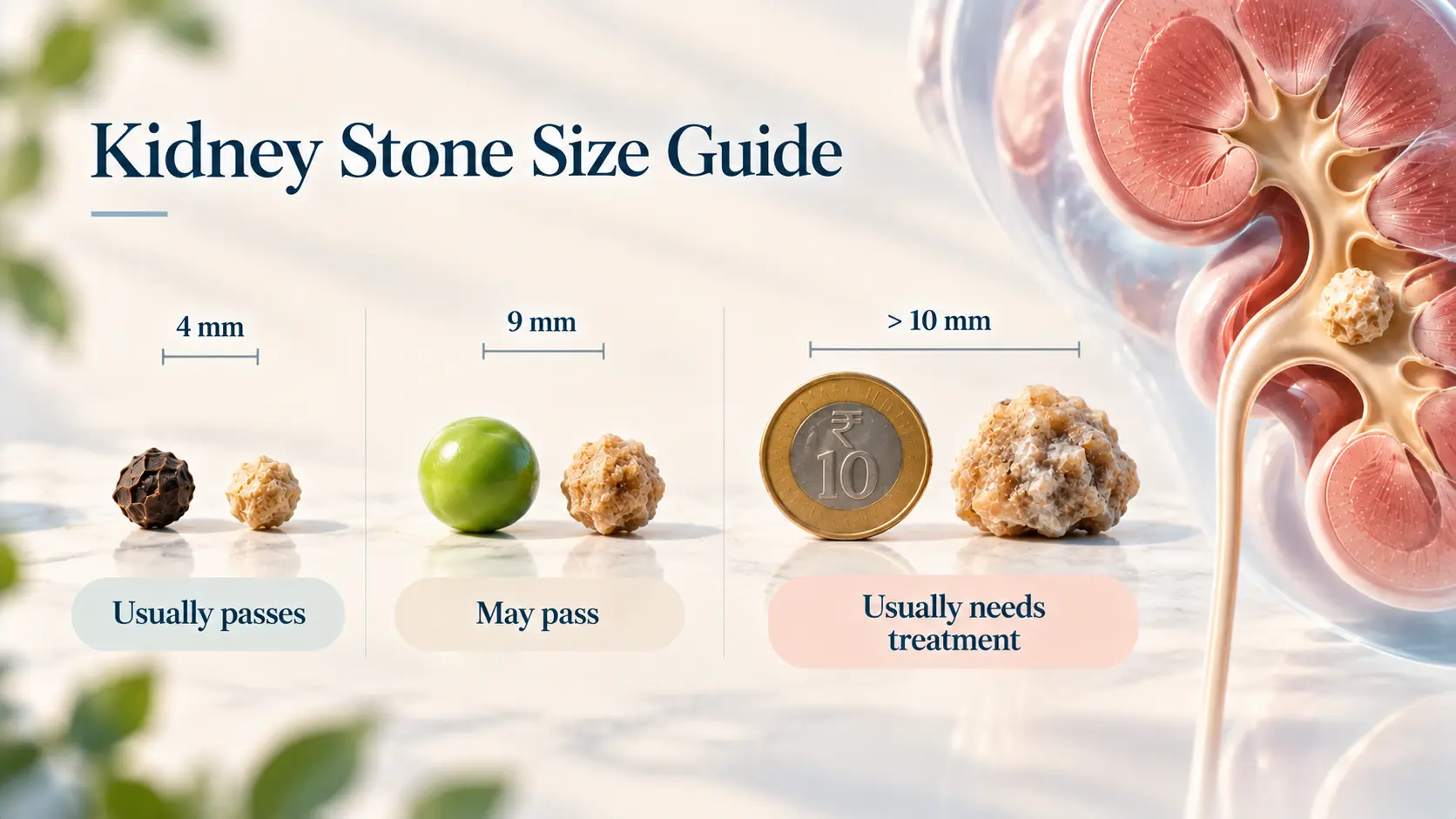
| Stone size and place | What usually happens | Treatment our urologists usually suggest |
|---|---|---|
| Under 5 mm, in the ureter | Most pass on their own, often within 4 to 6 weeks | Pain relief, enough fluids, follow-up scan |
| 5 to 10 mm, in the ureter | About half pass. Stones lower down pass more easily | A watchful trial if pain is controlled and there is no infection. A procedure if it does not move |
| Over 10 mm, in the ureter | Unlikely to pass on its own | Usually ureteroscopy with laser |
| Small, inside the kidney, causing no trouble | May stay quiet for a long time | Often watched with periodic scans |
| 1 to 2 cm inside the kidney, or growing or painful | Will not pass easily | Shock wave treatment or a flexible scope (RIRS) |
| About 2 cm or more inside the kidney | Will not pass | Usually PCNL, a keyhole procedure |
But before you match your stone to this table, there is one catch. The number on your report may not be the true size.
"Is the Size on My Ultrasound Report Accurate?"
Not always. Ultrasound is a good first test, but research shows it often reads stones as larger than they really are. This is especially true for stones of 5 mm or less. Ultrasound can also miss stones that are inside the ureter.
A plain CT scan of the kidneys, ureters and bladder (CT KUB, done without dye) measures size and position more accurately. Not everyone needs one, and in pregnancy CT is contraindicated and ultrasound (USG) is preferred.
We often meet patients carrying two reports from two centres, with sizes a couple of millimetres apart. That is why our urologists do not decide on surgery from one ultrasound line alone.
So size and place set the baseline. The next question most people ask is whether a small stone can ever be serious.
"Can a Small Stone Still Need Surgery?"
Yes. A stone of any size needs prompt treatment in these situations:
- Fever, chills or shivering with stone pain. Infected urine trapped behind a stone can spread into the blood. The first step is usually draining the kidney, either with a stent or with a thin tube through the back (nephrostomy). The stone is removed later, once the infection is under control.
- Only one working kidney, or both sides blocked. There is no backup kidney to cover for the blocked one.
- Pain that medicines cannot control, or vomiting that will not stop.
- Kidney function falling on blood tests, or the swelling getting worse.
- A stone that has not moved after a fair trial of about 4 to 6 weeks.
Work can matter too. If you drive long distances or travel often, a sudden attack on the road can be risky. Treating a modest stone earlier may be worth discussing.
If none of these applies, waiting can be a sensible plan. That brings up the next question.
"How Long Can I Wait, and What Can I Do at Home?"
For many stones in the ureter, a trial of about 2 to 3 weeks is reasonable. That holds as long as the pain is controlled, there is no infection, and you are checked along the way.
During this time, your urologist may prescribe an alpha-blocker, a medicine that relaxes the ureter. Research suggests it helps some stones pass, especially larger ones lower in the tube, though study results are mixed. Take it only if your doctor prescribes it.
Many patients tell us, "The pain stopped, so the stone must have gone." Not always. A stone can stay stuck and keep blocking quietly once the pain settles. That is why a follow-up scan matters even when you feel fine.
Then come the home remedies. In many Bengaluru homes, the advice is drink horse gram rasam; the stone will melt away. Friends say, "Thoda beer pi lo, stone nikal jayega."
Here is the honest picture. Drinking enough fluid does help a small stone move, and it lowers the chance of new ones. But there is no good evidence that horse gram, beer or any juice dissolves a common calcium stone stuck in the tube. Alcohol can even leave you more dehydrated. The real exception is a uric acid stone, which can sometimes be dissolved with prescribed medicines after tests.
If waiting doesn't work, the next concern is usually the procedure itself.
"If I Do Need Surgery, Will There Be a Cut?"
For most people, no. Most stones are treated with shock waves from outside the body or with a thin scope passed through the natural urine passage.
- ESWL (shock wave lithotripsy): Shock waves from outside the body break the stone into pieces that pass in the urine. Some people need more than one session.
- URS (ureteroscopy) with laser: A thin scope goes up through the urine passage into the ureter, and a laser breaks the stone. No cut.
- RIRS (retrograde intrarenal surgery): A flexible scope travels into the kidney itself. No cut. It is often used for kidney stones under about 2 cm.
- PCNL (percutaneous nephrolithotomy): A small keyhole in the back reaches large or branched kidney stones.
- Open surgery: Now rarely needed.
After a scope procedure, a temporary soft tube called a DJ stent is often left inside to keep urine flowing while things heal. It can cause an urge to pass urine, some discomfort and a little blood in the urine. It is removed later. We explain the stent before the procedure, not after.
Two worries come up in almost every consultation: cost and time off work. Both depend on the procedure, the stone and your insurance, so our team explains them clearly before any date is fixed.
So how does our team decide which of these, if any, you actually need?
"What Happens When I Come to Ramakrishna Hospital for My Kidney Stone Treatment?"
Our urologists start with your story. They ask when the pain began, about any fever or vomiting, past stones, stones in the family, how much water you drink, your work and the medicines you take. Then comes an examination, including your temperature.
- Urine test for blood and infection.
- Blood test for kidney function (creatinine).
- All your scans, side by side, with a CT KUB if the size or position is unclear.
- A shared decision on whether to wait, take medicines or plan a procedure, with the reasons explained.
This is how we answer what size of kidney stone needs surgery for you, not for an average patient. And sometimes, after all of that, the advice is to do nothing for now.
"Is Waiting Ever the Better Choice?"
Yes, often. Waiting is usually right in two situations. One is a small kidney stone found by chance that is not blocking anything. The other is a small ureteric stone that is moving while your pain is controlled.
We would rather you avoid a procedure you do not need than have one because a number on a report looked scary. But watching is not the same as forgetting. Keep your follow-up scans, and come back early if anything changes.
"Once It Is Out, Will It Come Back?"
It can. About half of people who have one kidney stone develop another later in life. That is why, when a stone comes out, our team likes to send it for analysis. For people who keep forming stones, urine tests can help find the cause.
Drinking enough through the day to keep your urine pale is the simplest habit that helps. Beyond that, diet advice depends on your stone type, so testing works better than general rules.

Normal vs See a Doctor Soon

Usually expected while passing a small stone
- Pain that comes in waves and settles with prescribed painkillers.
- Pinkish urine or mild burning while passing urine.
- Pain that moves lower, towards the groin.
- Passing a tiny gritty piece in the urine.
See a doctor the same day if you have
- Fever, chills or shivering with stone pain.
- Vomiting that stops you from keeping down fluids or medicines.
- Pain your medicines do not control.
- Very little or no urine.
- Stone pain with only one working kidney.
- Side pain during pregnancy.
The Number on Your Report Is Where the Conversation Starts
Go back to that report with the circled line. The number is useful. It is just not the whole answer.
So, what size of kidney stone needs surgery? Sometimes a 4 mm stone, if it is blocked and infected. Sometimes not even a 12 mm one, if it sits quietly inside the kidney.
Size, place, symptoms and kidney health decide it together.
You may have been searching for urologists or a urology hospital in Jayanagar, Bangalore, for a clear opinion on your report. Bring all your scans to Ramakrishna Hospital. Our urology team will look at your stone, not just the number.
Frequently Asked Questions
Can a 6 mm kidney stone pass on its own?
Often, yes, especially in the lower part of the ureter. About half of stones between 5 and 10 mm pass without a procedure. If pain is controlled and there is no infection, a few weeks of watching with a follow-up scan is usually reasonable.
Is a 10 mm stone always an operation?
In the ureter, most stones of this size need a procedure, usually a scope with no cut. Inside the kidney, a 10 mm stone that causes no symptoms may sometimes be watched.
Can medicines dissolve my kidney stone?
Most stones are calcium-based and cannot be dissolved by medicines or drinks. Uric acid stones are the exception. Do not stop any medicine you already take without talking to the doctor who prescribed it.
Does a DJ stent hurt?
Many people feel some discomfort, an urge to pass urine often, or see a little blood while the stent is in. This usually settles once it is removed. Report fever or severe pain straight away.
Disclaimer: This article is for informational purposes only and does not replace professional medical advice, diagnosis, or treatment. Consult a qualified urologist for an individual assessment and appropriate treatment.