
If the pain stays in your lower back, it is usually regular back pain. If it travels down one leg, often below the knee, with burning, tingling or numbness, and your leg hurts more than your back, it points towards sciatica. Both usually settle with gentle movement and time. A few warning signs need urgent care.
You're on your two-wheeler, waiting at the signal near South End Circle. Your back has been aching all week. Nothing new.
But today the ache has moved. It's in your buttock now. It runs down the back of your left leg.
Then you sneeze. Something shoots straight down to your calf.
Is this sciatica? Or just regular back pain that got worse?
The answer to sciatica vs. regular back pain comes down to one thing: where the pain goes. Pain that stays in your back is usually regular back pain. Pain that travels down one leg, often with tingling or numbness, is more likely sciatica. Let us explain how to tell, what we check, and when you should not wait.
What Is the Real Difference Between Sciatica and Regular Back Pain?
The difference is where the pain lives. Regular back pain stays mostly in your lower back. Sciatica is leg pain that starts from your back.
Sciatica happens when the sciatic nerve gets irritated or pressed. This nerve starts in your lower back. It runs through your buttock and goes all the way down to your foot.
So when the nerve is irritated, you feel it along that path. Your buttock. The back of one leg. Sometimes your foot and toes.
That raises an obvious question. If the problem is in the back, why does the leg hurt?
"Doctor, Why Does My Leg Hurt When the Problem Is in My Back?"
Your leg hurts because the nerve starts in your back but is felt along its whole length.
Think of a garden hose. Step on it near the tap, and the water stops at the far end of the garden. Nothing is wrong with the far end. The problem is where your foot is pressing.
The sciatic nerve works similarly. It gets pressed near the spine, but you feel the pain, tingling or numbness further down, in your calf or foot.
What presses on it? The most common cause is a slipped disc. Between the bones of your spine sit soft cushions called discs. When one bulges out, it can press on a nearby nerve.
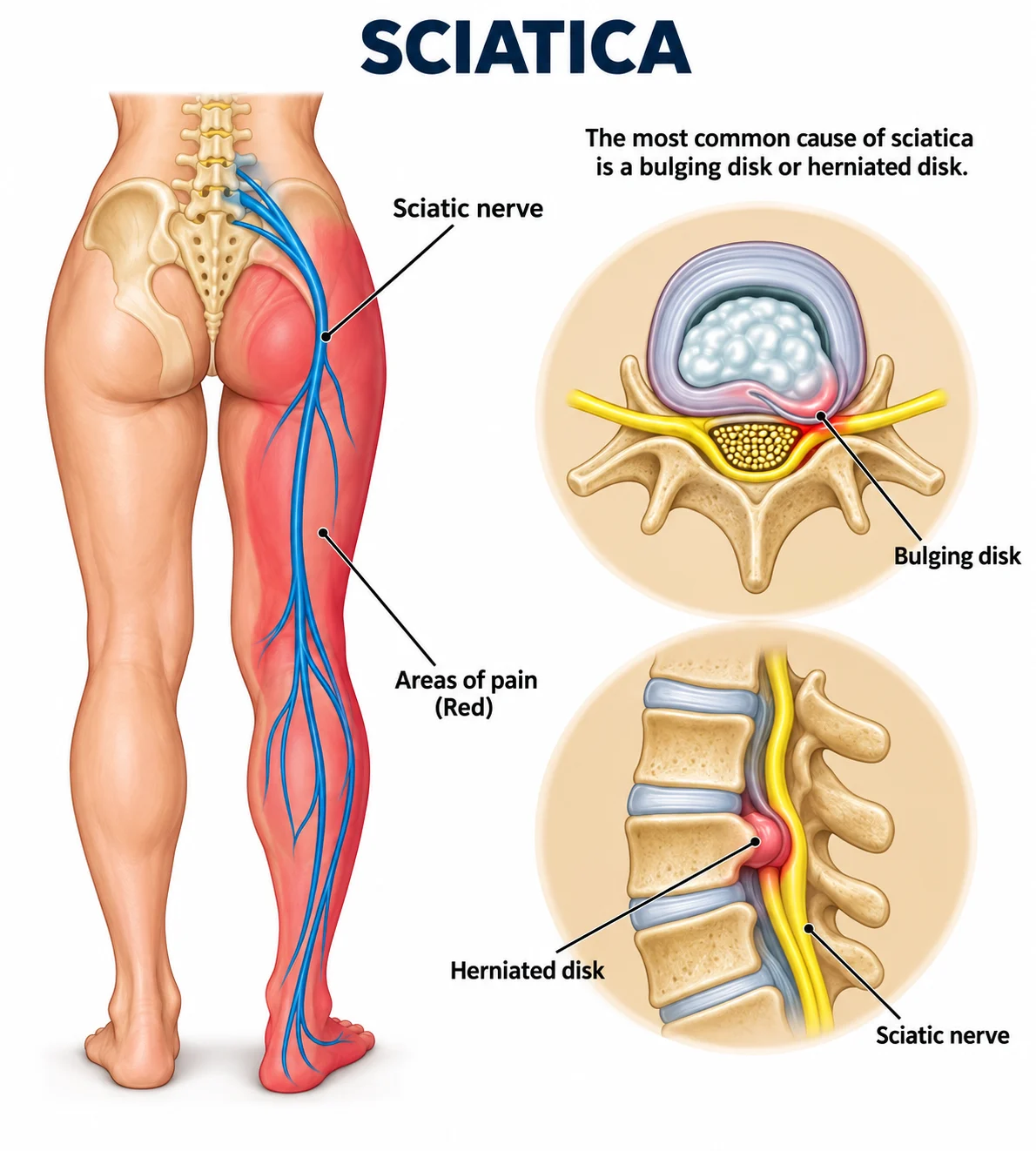
Other causes include:
- Spinal stenosis: the channel the nerves pass through becomes narrow.
- Spondylolisthesis: one bone of the spine slips out of position.
- A back injury.
So what happens when the pain stays in your back and never goes down your leg?
What Does Regular Back Pain Usually Feel Like?
Regular back pain usually feels like a dull ache, tightness or stiffness in the lower back, between your ribs and your buttocks.
Most back pain is what doctors call "non-specific." Many structures in the back work closely together, including muscles, ligaments and small joints. Often no single cause can be found. This does not mean your back is damaged.
Too little movement can play a part. So can too much strain. Even stress can make the muscles tense up.
Often our patients in Bengaluru complain about:
- Stiffness after a long drive home in traffic.
- An ache after lifting a full water can or a gas cylinder.
- A sore back after festival cleaning before Deepavali.
- Getting up slowly after sitting cross-legged on the floor during pooja.
Many people simply call it sonta novu (back pain). It feels heavy and tight. It may feel worse when you bend and ease a little when you move around.
But what if you honestly cannot tell which one you have?
Sciatica vs Regular Back Pain: How Can You Tell at Home?
You can get a good idea by noticing where the pain goes and what it feels like.
| Regular back pain | Sciatica | |
|---|---|---|
| Where it hurts | Lower back, sometimes spreading into the buttock | Buttock and back of one leg, often below the knee, sometimes to the foot |
| What it feels like | Dull ache, stiffness, tightness | Sharp, burning, electric or shooting pain |
| Back vs leg | The back hurts most | The leg usually hurts more than the back |
| What makes it worse | Bending, lifting, staying in one position | Moving, coughing, sneezing, long sitting |
| Other feelings | Usually just pain and stiffness | Pins and needles, numbness or weakness in the leg or foot |
| Which side | Across the back or one side | Usually one leg |
Some patients describe it simply: "Doctor, kaalu jhum anta ide." (My leg feels numb and tingly.) That "gone to sleep" feeling in one leg is often a sign that a nerve is involved.
This table is a guide, not a diagnosis. Some pain sits in between. A hip joint problem or a tight buttock muscle can cause pain around the buttock and thigh.
Spinal stenosis behaves differently too. It often brings buttock and thigh pain when you walk or stand for a long time. It eases when you sit down or lean forward, like leaning on a shopping trolley.
This is where an examination tells you more than anything you read online.
What Does Our Orthopedic Team Check in the Consultation?
We check whether a nerve is involved and how much it is affected.
We are not only asking, "Is there a disc bulge?" We are asking, "Is a nerve being pressed? How strongly? Is it getting better or worse?"
In the consultation, our orthopedic doctors usually look at:
- Where the pain goes, when it started and what makes it worse.
- How you walk. Small changes in walking can point to nerve trouble.
- The straight leg raise test. You lie flat. We slowly lift one leg with the knee straight. If this brings on your leg pain, a nerve is likely irritated.
- Strength. Can you walk on your heels and on your toes? Is one foot weaker?
- Feeling and reflexes in your leg and foot.
- Warning signs, including any change in bladder or bowel control or numbness around the private area.
Many people search for the orthopedic hospital in Jayanagar, Bangalore. What matters most is a team that examines you properly before suggesting any scan or surgery.
Which brings us to the question almost everyone asks next.
"Doctor, Do I Need an MRI Right Away?"
Our orthopedic doctors guide you on whether you need an MRI or not, depending on the severity.
The reason surprises people. Changes in the spine are very common as we get older, even in people with no pain at all.
Think of an old car that has driven on Bengaluru roads for years. It has small dents everywhere, and it still runs fine. An MRI can show dents like these in the spine. Some of them have nothing to do with your pain.
A scan can find a bulge that isn't the real cause, and that can lead to worry or treatment you don't need.
A scan makes more sense when:
- Symptoms are not improving after several weeks of proper care.
- Weakness in the leg is getting worse.
- A serious cause is suspected.
- An injection or surgery is being considered.
A scan does not treat anything. It helps us plan once we know what we are looking for.
So if not a scan first, what actually helps?
How Are Sciatica and Back Pain Treated?
Both usually start the same way: keep moving gently and give your body time.
Sciatica usually gets better in a few weeks to a few months. Sometimes it lasts longer, and it can come back.
What usually helps:
- Carrying on with your normal activities as much as you can.
- Gentle exercises and stretches, as your doctor or physiotherapist advises.
- Heat packs on the sore area.
- Physiotherapy.
- Pain relief prescribed by your doctor, rather than buying the same strip from the chemist for weeks.
At home, the advice is often complete bed rest. For most back pain and sciatica, lying down for days is not the answer. Moving may hurt, but it is not harmful, and it can help you recover faster.
For regular back pain treatment, the focus stays on movement, building strength and fixing how you sit and lift.
When pain is severe and does not settle, sciatica treatment may go further. Options include an injection near the nerve, a procedure to calm the pain signals, or surgery to take pressure off the nerve.
Surgery is not the first answer for most people. It is usually for a smaller group: those whose pain stays disabling despite proper treatment, whose weakness is getting worse, or who have emergency signs. And if surgery is not right for you today, that does not mean it is ruled out forever.
What Is Normal, and When Is Sciatica an Emergency?
Most sciatica is painful but not dangerous. A few signs, though, need a hospital straight away.
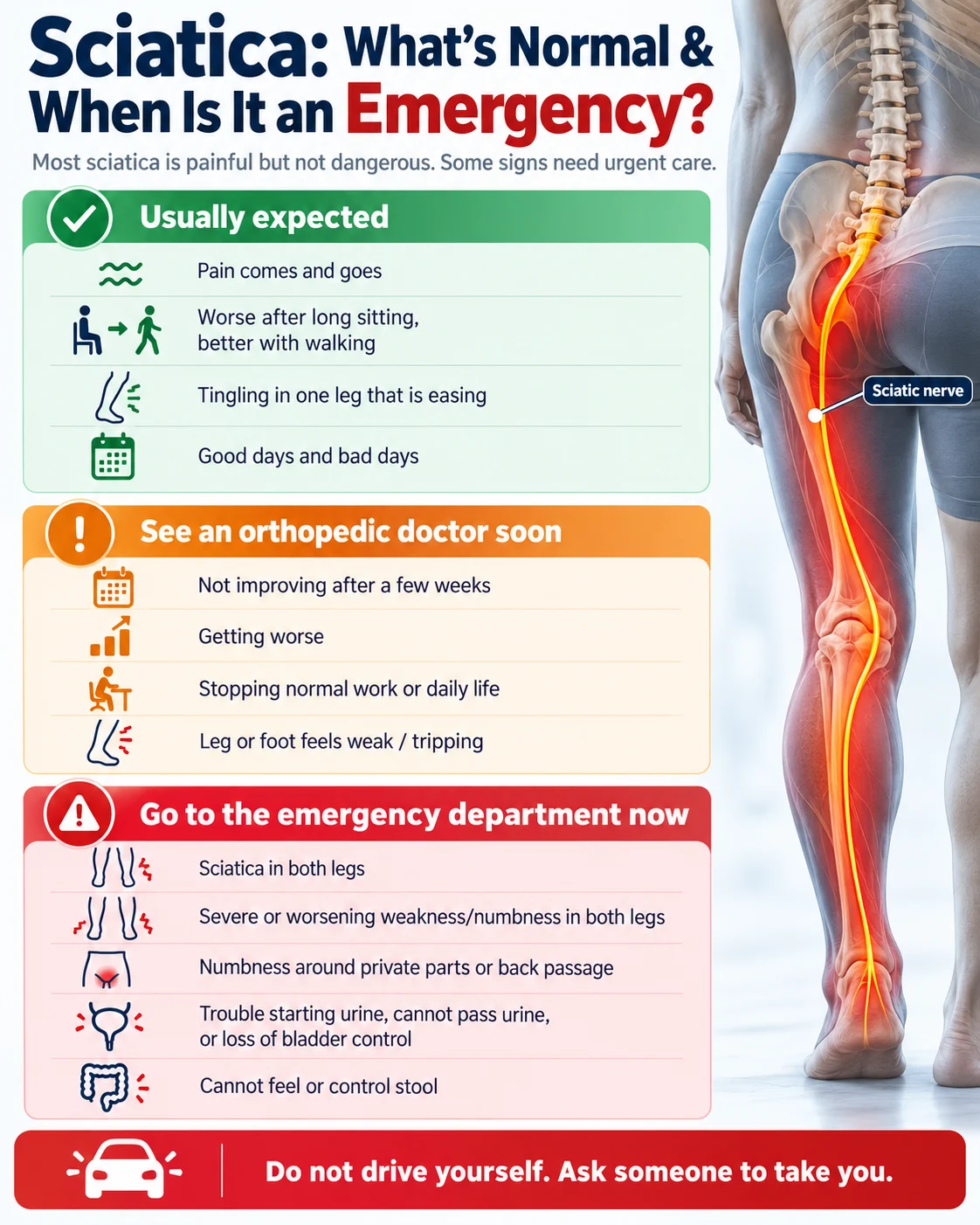
This is usually expected while it settles
- Pain that comes and goes over days.
- Pain that is worse after long sitting and better when you walk around.
- Tingling in one leg that is slowly easing.
- Good days and bad days.
See an orthopedic doctor soon if
- The pain has not improved after a few weeks.
- It is getting worse.
- It is stopping you from working or doing normal things.
- Your leg or foot feels weak, or you keep tripping.
Go to the emergency department now if you
- Have sciatica in both legs.
- Have weakness or numbness in both legs that is severe or getting worse.
- Have numbness around your private parts or back passage.
- Find it hard to start passing urine, cannot pass urine, or cannot control it, and this is not normal for you.
- Do not notice when you need to pass stool, or cannot control it, and this is not normal for you.
Do not drive yourself. Ask someone to take you.
Families often notice first. A slight limp. A foot catching on the steps. Someone who has quietly stopped sitting through meals. If you see this in a parent or partner, don't wait for them to bring it up.
Frequently Asked Questions
Can sciatica go away on its own?
Yes, it often does. Sciatica usually improves within a few weeks to a few months with gentle activity and simple care. It can last longer and can come back. If it doesn't improve after a few weeks, or if it gets worse, see an orthopedic doctor.
Is sitting for long bad for sciatica?
It can make it worse for many people. Long sitting often increases leg pain when a nerve is irritated. Break up your sitting time. Get up and walk around every so often, even for a minute or two, whether you are at a desk or on a long drive.
Can regular back pain turn into sciatica?
It can happen. The same disc that causes back pain can later press on a nerve, and then the pain starts travelling down the leg. If you notice new leg pain, tingling or numbness, get it checked rather than waiting it out.
Should I take complete bed rest for back pain or sciatica?
No. Resting on a very bad day is fine, but lying down for long periods is not advised. Gentle movement and carrying on with daily activities as much as you can usually helps you recover faster.
Is sciatica always caused by a slipped disc?
No. A slipped disc is the most common cause. Narrowing of the spinal canal, a slipped spine bone or a back injury can also press on the nerve. An examination, and sometimes a scan, helps find the actual cause.
When should I see an orthopedic doctor for back pain?
See one if the pain goes down your leg, is not better in a few weeks, is getting worse, or is stopping your normal day. See one sooner if your leg feels weak or numb. Go to emergency straight away for the warning signs listed above.
A Final Message From Our Orthopedic Team
Go back to that sneeze at the signal near South End Circle.
It was telling you something. Pain that stays in your back and pain that travels down your leg are two different messages from your body. Most of the time, both settle. What matters is noticing which one you have, and knowing the few signs that cannot wait.
Listen to where the pain goes, not just how much it hurts.
If your back pain has started travelling down your leg, or simply isn't settling, our orthopedic doctors at Ramakrishna Hospital, Jayanagar 3rd Block, near South End Circle, Bengaluru, can examine you and explain what is going on.